So hi blog readers. The term has ended and technically this project is over. I would really love to continue updating but realistically I doubt I will find time. Maybe here and there.
An other part of this project I didn't really mention was the research and capstone paper part. I ended up writing about the use of online activism in the fourth wave of feminism. Some people still say we're in the third wave, but I'm one of those folks who is pretty sure we've moved on to the fourth. My conclusions in my paper were basically that part of the major shifts between the third and fourth waves is communication and organizing style- primarily the use of the internet. One of the reasons this is a big deal is because the fourth wave is being met with a large post feminist attitude and we need a new style of communication and organizing to get people to care again.
A great example of this is the Who Needs Feminism? project. It is a tumblr began by a group of university studies who wanted to fight back against this post feminist attitude. Their project features images of people holding signs stating why they need feminism. These signs can act as a strong wake up call that feminist issues still exist and are a big deal. We're not finished feminists, we've still got a long ways to go.
For more images, or to submit your own, check out the website.
Caution: The author’s perspectives on body positivity do not relate to all people. We each have different
experiences, so it is entirely possible that the following words will not apply to you or accurately reflect
your identity. Societal pressures different across spectrums of race, class, and gender and the author has
not experienced all of them because of her various positions of privilege.
In our society, bodies are never really appreciated. We often complain when they are tired, hungry,
or sick instead of focusing on how amazing they are. While I am not an expert on anatomy, I do know
that the systems of our bodies are extremely complex. However, we often only focus on the outward
appearance of our bodies – what other people see of us. This image is constantly policed by the media,
our peers, and even sometimes our family members. This negativity surrounding body image is probably
one of the main reasons why people feel uncomfortable with the way they look. Our society tells us that
we are less than enough – not skinny enough, not pretty enough, not desirable enough. Many people
are not even represented in the media, and when they are these representations tend to be negative.
For example, people who are dis/abled are not frequently represented in advertisements, sending a
message that these bodies are not normal or desirable. Fatness is occasionally represented in the media,
but only to poke fun at people who society deems as “obese”.
There are very few representations of people who love their bodies, especially people with marginalized
identities. So what can we do about this? How can we increase our body positivity in a world that does
not give us a model for doing so? Below are several ideas that you can incorporate into your daily lives:
• Talk to your friends and family members about body image. Share experiences. These discussions may not be easy, but they are important to have.
• Increase your media literacy. Learn the best practices for critically analyzing the messages that are sent your way.
• Compliment yourself and others. Leave notes, think encouraging thoughts, and let yourself and others know that they are good enough just as they are.
• Stop participating in diet culture. It’s one thing to care about your appearance, but it’s another thing to let it control your life. Extreme dieting is not effective and it is unhealthy in many cases. As an alternative, look into organizations like “Health at Every Size”.
• Enjoy things you like about yourself and accept things that you don’t. This is obviously easier said than done, but it is important to focus on all aspects of your body, even the parts that you might not be as fond of. Body positivity is about your whole self.
• Think about where your messages on body image originated from. Can this information help you in addressing your current worries and issues related to your body image?
Gender is a big topic to jump into, but its one that really deserves time in any exploration of feminism. Like with intersectionality, its important to take into account more than one identity when thinking about social activism. If I'm going to say I want to fight for equity for women, why not also fight for equity of race, of religion, of sexual orientation? While we're at it, we also need to fight for equity of all genders, not just for women.
Before I go any further, I want to get one thing out of the way.
There are more than two genders.
Once more.
THERE ARE MORE THAN TWO GENDERS.
Ok, moving on. Its been pretty well established that feminism aims to have the rights, needs and lives of women be equitable to those of men. Its saying that men and women are all people, so why are we treated differently? But what you can't leave out is the fact that gender goes way beyond men and women. This is because gender is a spectrum!
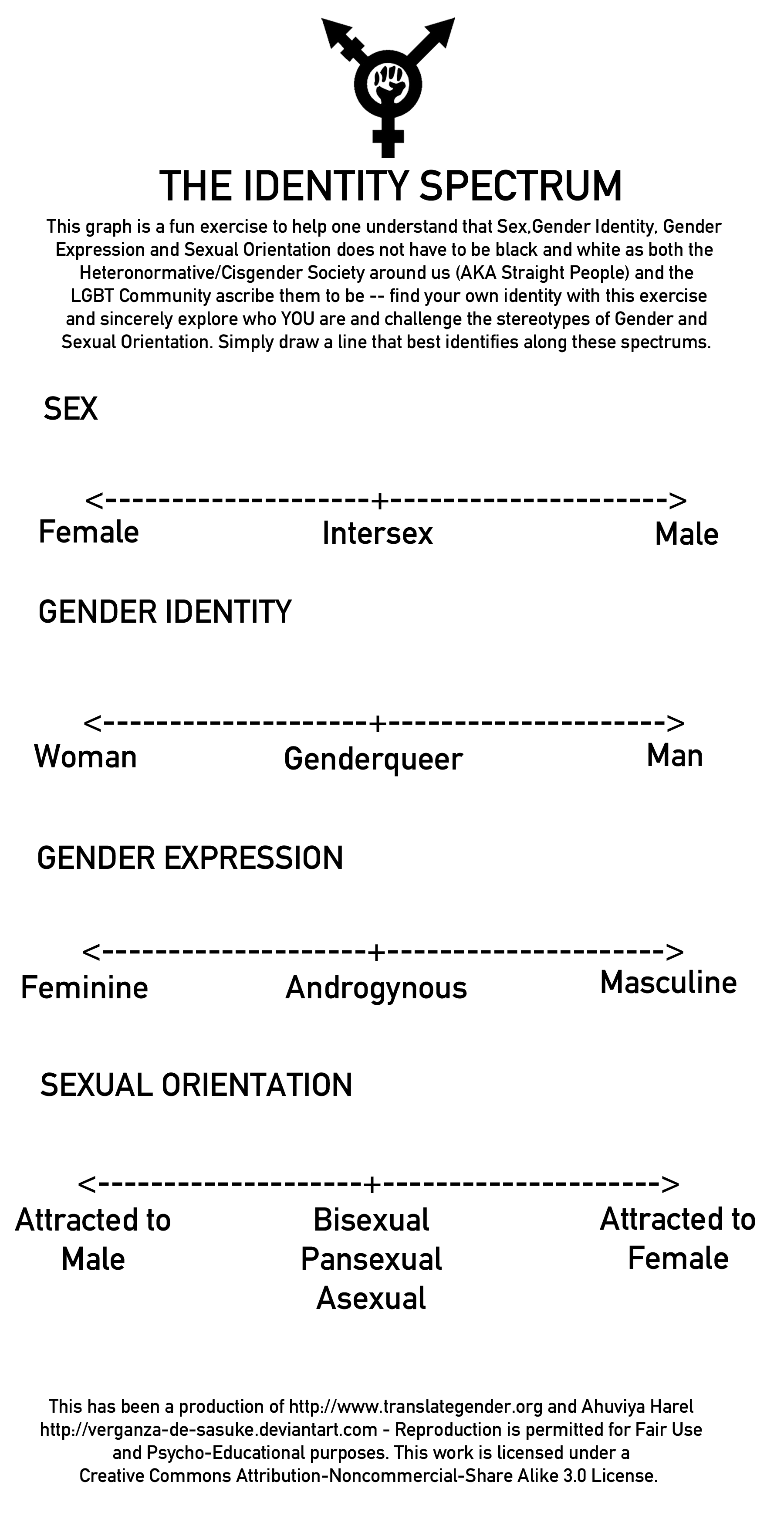
This chart shoes a few awesome spectrums, and for clarity here are a few definitions to go with that.
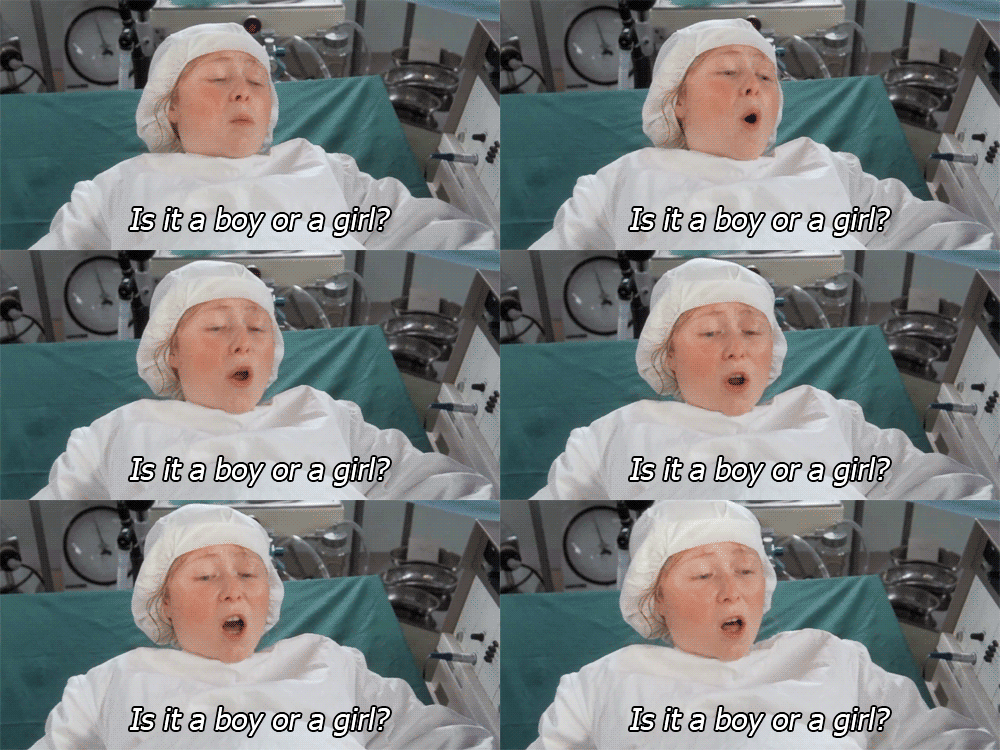
Sex is your body when you're born. You're born and the doctor looks between your legs. You could have a vulva and be called female, a penis and be called male or you could be somewhere in between and called intersex.
Gender Identity is how you feel! You can feel like a woman, a man or anywhere in between. This image shoes genderqueer as the center, but there are lots of other words that can also be used to describe someone who feels not quite at one end or the other of the spectrum.
Gender Expression is how you choose to show off how you feel, or how you want people to view you.
Sexual Orientation is who you like. At one we've got attracted to female and the other we've got attracted to male. I think this one could stand to be a little differently worded, or even a different shape than a linear spectrum. By using the words male and female, we're talking about sex (as in your genitals, not fucking). So this says one side is people who dig penises and the other is people who dig vulvas. In the center have bisexual (being attracted to both men and women), pansexual (being attracted to people regardless of gender) and asexual (not feeling sexual attraction).
This chart is a great starting point, but I think it is really important to remember that people can exist on multiple locations on these spectrums, and just because they are at one end on one, doesn't mean they need to be at the same end on another. Its all totally changable too! You may identify at one end of the spectrum one day and be feeling different the next. It is also totally up to the individual. Someone's sexual or gender identity is their own decision and it isn't up to you to place them on this chart.
Oh goodness there is so much more to talk about with gender, but there are already a lot of words on this post. So more next time!
There are a lot of posts I've started, but never finished on here. Mostly its because I start to ramble and go way beyond the basic ideas I planned to share.
One of those posts was about intersectionality, because its such a big topic I can't help but to ramble about it.
What is intersectionality you ask? The gist of it is that we all have multiple identities, and they all help to define how we see the world. A queer feminist is going to see the world differently than a straight feminist, a black woman is going to see the world differently than a black man. Its pretty simple in that sense.
It gets a bit hairier when you think of how you also have to account for that in things like activism. You man want to focus on women's issues, but a black woman may have different concerns than a white woman, and a queer woman different than a straight woman. You've got to take a moment to step beyond how you experience the world, and consider that others see it differently. You can't always step into the shoes another person is in, to see how they experience the world. What you can do is check that you have looked beyond your own life experiences and expectations, and if someone does speak up about their own needs, listen.
I'm not really a sports person, but I've been paying a bit of attention to the olympics this year. There are obviously some big issues going on with Russia's anti-gay laws, and its been interesting to see how individuals, corporations and other countries have spoken against them. One video, put out by The Canadian Institute of Diversity and Inclusion, jumped out at me particularly, because they play with the idea of male gaze in an interesting way.
Can you spot the difference?
Usually we are more familar with seeing this image on the sports page...
But what if we viewed men's sports like that too?
The male gazze is usually defined as the heterosexual male's gaze, but Canada has given us a lovely example of what happens when you turn that into the homosexual male's gaze.
If you want to look into this a tad more, hop on over to this article, where you can read and see more about the photography of women's vs men's sports.
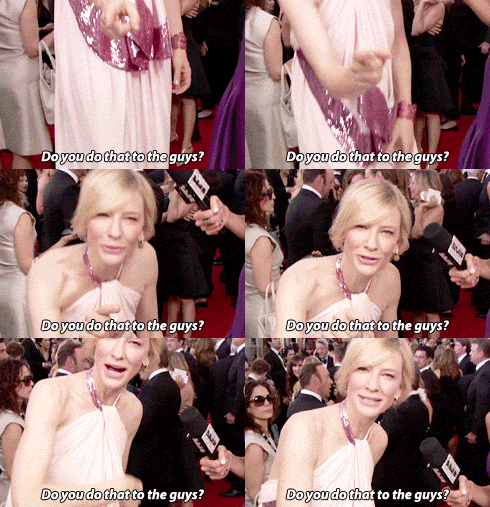
But lest we forget, its not just sports that is focusing on hilighting the female body, its everywhere!
So take a tip from the wonderful Kate Blanchett, and call it out when you see it. Most people don't even realize its going on.
One thing mentioned in the Laci Green video that I wanted to continue on a bit was the idea of male gaze.
The concept of the male gaze comes from feminist analyzation of film. It points out that most film is created from the point of view or with the audience of heterosexual male viewers in mind. These manifest itself in the types of characters, the way shots are set up and the plots and themes.
Example? A female character who is only in a movie to be the girlfriend character. In every scene she looks attractive and is there for the viewer to look at.
Its kind of hard to avoid these types of things, cause so many movies use the male gaze. Sometimes if you can't avoid it, you can alteast know what is going on. And this is where the tests come in.
There are a lot of different tests you can use to see if a movie or TV show is using the male gaze. The most commonly referred to is the Bechtel Test.
the Sexy Lamp test (courtesy of Kelly Sue DeConnick): can you replace your female character with a sexy lamp and still have the story work?
the Mako Mori test: there is a) at least one female character, b) who gets her own narrative arc, c) that is not about supporting a man’s story.
And a new one that has popped up on tumblr...
the Tauriel test a) there is a woman, b) WHO IS GOOD AT HER JOB. (Hint hint. Skyfall doesn't pass.)
So maybe you're not going to stop watching movies that don't pass this test, but what I'd encourage you to do is just be aware of it. If something doesn't feel quite right to you in a movie, or if you're wondering why the sex scene is longer than the major plot points, check back to these tests. The male gaze may be why.
It was about time to get some additional medias involved here on this blog and what better way than sharing the fabulous Laci Green. For those unfamiliar with her, Laci Green is an awesome sex educator who among other things makes fantastic youtube videos about all kinds of topics. I'm only going to share one today, but I highly encourage you to go to her youtube channel and watch some more videos.
I chose this particular video to share because it mentions a lot of important issues that are worthy of your time. Some of these things include the male gaze, women's portrayal in advertising and what this blog is all about, what you can do about it!
So if you're still wanting more, check out some more videos! Most of Laci Green's videos are around 5 minutes in length and cover subjects from diets, slut shaming and dating advice, to how to choose a sex toy and where the g spot actually is.
Do y'all have any favorite Sex+ videos? Share them in the comments!
hey. I just wanted to do a quick post to talk about the difference between equity and equality.
A lot of social justice folks talk about equality.
With equality, we're saying everyone has the same opportunities, and is treated the same as everyone else.
Which is great! But let me give you a different way to think about it.
If a person is diagnosed with cancer, and needs to get radiation therapy, equality says he should be able to get the treatment he needs. The thing is, not everyone needs to get radiation therapy. If I fall and break my arm, I should be able to go and get a cast, but not everyone needs a cast on their arm.
Have you ever heard the argument, if you don't like gay marriage, don't get one? Its the same thing. If you're gay and want to get married, you should be able to, but not everyone needs to marry someone of the same sex.
Equity says, everyone should be able to get what they need. If you break your arm, you get a cast. If you want to go to college but don't have the money, you'll get some help. Everyone gets what they need, because they need it. Not just because they have the money, a certain skin tone, etc.
I recently heard an argument about correct definitions of terms. There are a lot of terms we don't often use the full, correct definition for, but many people use a similar, shared definition. The example used was using the term racism, when you may actually mean prejudice based on race. Equality is one of those words.
A lot of people use the term equality, but what they probably mean, is equity. I still use equality in a lot of conversations, but when the time is right, I'll break out the more accurate term, equity.
Okay, that wasn't so quick. But you learned something important! Hooray!
If you haven't heard, Selfie was named word of the year by the Oxford Dictionary for 2013 [x]. Officially, it is defined as "A photograph that one has taken of oneself, typically taken with a smart phone or webcam and uploaded to a social media website." [x]
But why do you care? Because selfies are pretty fucking powerful, thats why. In a billion dollar beauty industry focused on convincing us we don't look good enough and need their products, something focused on self celebration and showing off how good we look is a big deal. We are saying "Fuck you, we will look good however we feel we look good, and don't need you to tell us how to look." But the important thing to remember is this means different things to different people! To someone, showing off how good they look sans makeup may mean power. To someone else, taking a photo to document how perfect their eyeliner is that day may be what they need. Just because we're saying screw the beauty industry's standards, doesn't mean we can't still appreciate and use their products.
This issue isn't new, its something second wave feminists dealt with a lot, and defines the split between the radical liberation feminists and the radical cultural feminists. Some people felt in order for women to be empowered, they had to deny anything feminism and try to be either more masculine or androgynous to reclaim their power. Others wanted to celebrate the feminine identity and be extra feminine!
In today's world we respect both, and need to realize that the big issue at play is choice. Its not about which is better, but that we're free to do whatever we think its for us. If that means wearing no makeup and sweats, thats fine. If that means caking on the makeup with a mini skirt and stilettos, thats cool too.
Unfortunately, its not always as easy as that. Saying that its fine to do whatever you want, wont stop the judgement and expectations from others based on what you wear or how you look.
There are days I leave the house in a particularly feminine get up, and feel guilty as soon as I start talking about carpentry, or welding. I feel my identity as a woman who works in a male dominated industry is betrayed for wanting to wear a dress or high heals.
There are days when the opposite happens, I go out in work boots and baggy paint stained clothes, and I feel unattractive or unimpressive.
I will follow both of those by saying there are also days when I go out in a cute dress and feel kick ass for surprising people with my knowledge of carpentry, and days when I leave the house in my gross work clothes and love to see the reactions when I act particularly nice and sweet.
It all comes down to who you want to be, and accepting that who you want to be may change from day to day. But if you like who you are today, go ahead, take a picture. Show off who you are, and why that is so great.
Viva la selfie.
For further reading, check out...
"The Clothes I Wear Help Me to Know My Own Power" by BETTY LUTHER HILLMAN
Now, I don't want to fall into a pattern of just reposting stuff and telling you what other people think, but there is cool stuff out there, and I want everyone to know.
I found this list via Facebook, and am excited to explore this author's articles further.
So here ya are...
18 Things Women Shouldn't Have To Justify JAN. 4, 2014 By BRIANNA WIEST
1. Putting themselves first. When Barbara Walters asked Michelle Obama if it were selfish that she openly makes herself her first priority she responded: “No, no, it’s practical…. a lot of times we just slip pretty low on our own priority list because we’re so busy caring for everyone else. And one of the things that I want to model for my girls is investing in themselves as much as they invest in others.”
2. How little or much they’re eating, especially if it’s “unhealthy.” You can eat a big lunch without having to say “I haven’t eaten anything all day” or have some delicious ass nachos without saying “I totally deserve this, I was so good this week, I’ll start the diet again tomorrow.” More importantly, you shouldn’t have to always be interrogated with “that’s all you’re having?” or “you’re going to eat all that?!”
3. Healthy eating as a means of actual health, not weight loss, because for some reason, people tend to be skeptical that a woman could actually just want to treat her body right and not be perpetually concerned with her size.
4. Not having baby fever. You aren’t more or less of a woman– or person– if having a child isn’t for you now or ever. You shouldn’t have to back it up with the reasons you’re not maternally inclined but will maybe consider it down the road because “who really knows– maybe someday!” when you do really know that you don’t want kids but don’t want to be glared at like a heartless monster.
5. Having baby fever. Nobody should have to face a flurry of interrogative questions when they proclaim that they do indeed want to have children young, because it’s just as acceptable to feel that way as it is the alternative. If you want to travel, you’ll travel. If you want to pursue a career in addition to motherhood, pursue you shall. As long as you are aware of the implications, no further justification to other people who don’t feel the same way is needed.
6. Whether or not they’re having sex, and to what degree. There doesn’t have to be a reason that you slept with so-and-so, and you don’t have to feel obligated to give an excuse for why you’ve been celibate.
7. Enjoying what would otherwise be called guilty pleasures because they’re “girly” things. They don’t have to be “guilty” pleasures, they can just be pleasures. You can enjoy getting your nails painted and wearing a skirt and re-watching 13 Going On 30 a thousand times without floundering in stereotypes.
8. “Looking like shit today.” Whenever a woman leaves the house looking anything less than airbrushed and runs into someone they know, they tend to feel the need to apologize for it. You don’t have to apologize to someone else for not being a certain way, you have to apologize to yourself for feeling like you had to in the first place.
9. Experimenting with sexuality. It doesn’t have to be because you were “lost and confused” or just “a wild crazy girl in college.” If you made out with a girl at a party because it was the cool thing to do, fine, if it was more than that, just call it for what it was.
10. Weight, because size actually does not determine what “a real woman” is or not.
11. Amount of makeup worn on any given day. If you want to rock it au naturale, you do that, you beautiful little thing, and if you want to work it like you’re in a drag show, you can do that too. Your face. Your rules.
12. Sometimes conventionally frowned upon clothing choices. You don’t have to say you wear leggings “because they’re so comfortable” or a really short dress because you’re just “being crazy tonight.” These things require no explanation, and you shouldn’t let other people pressure you into feeling as though they do.
13. Being upset about something that warrants an emotional response. You don’t have to apologize for feeling something or acting out on it if it’s real to you. The people who judge you for being a human being, and not being ultimately demure and emotionless and in your place, are the ones who need to apologize.
14. Moving for a relationship if one is invested and ready… or just putting a relationship first if it’s a healthy and happy thing or something you want/need to work on. There’s a big difference between being dismissive and walked on and stepping up and taking part as an equal in a relationship, a role that usually requires compromising and effort.
15. Wanting to get married young.
16. Not wanting to get married young.
17. Attractiveness despite something. You don’t have to justify your so-called-imperfections with that which you like about yourself– you aren’t attractive because you have great hair despite being a little overweight. You can be attractive without fitting into social conventions of it. The beauty continuum scale was constructed to make us all feel like shit and buy a lot of products to fix that. But beautiful is as beautiful does.
18. Passing social deadlines for things. Who cares if you’re 35 and as single as you were 15 years ago? Life doesn’t start when someone or something comes along and then society says it can. You don’t have to make excuses as to why you aren’t married or with child or working a traditional 9-5. Our lives weren’t meant to be scripted the same way. When you adopt someone else’s narrative, it’s because you aren’t hearing your own clearly enough.
Now let me tell you, I feel like I am constantly justifying things. The thing I hate most is 'are you okay?' when I'm totally fine. I always feel like I have to have some excuse for why I might have appeared off, even though I thought I was acting pretty normal. Its always 'oh yeah, I'm just tired' or 'yeah I'm just thinking about this thing' but rarely do I say 'yeah, I'm totally fine, was I acting not okay?'
Is anyone a regular reader of Brianna Wiest? Any good recommendations on what to read of hers?
To start things off, I've got a quick quiz for you to take. (Don't worry, its really fast)
I was going to be clever and write my own quiz, but this one is just too perfect.
Now that we've done that, congratulations! But what do you do now? Since you're a feminist does that mean you have to start going out to rallies and hating men? Nope just keep doing what your doing, but maybe now you can do it with your eyes open just a little wider. Obviously there are things in the world that aren't equal, and maybe shouldn't be. For example, just because some people need to have open heart surgery, doesn't mean everyone should have it. But what you can start noticing is when things aren't equitable. If someone needs open heart surgery, they should be able to get it. If someone needs birth control, they should be able to get it.
So yes, you can go out and protest for reproductive rights and healthcare for all, and that is great if you do! But don't feel like you have to do that to be a good feminist. Things that seem small can still make a difference, and the more people who do it, the bigger difference it will make. Hear a song that is putting down women? You could choose not to listen to it, you could use it to start a conversation about why its not cool to put down women. You don't have to go out and find the feminist war, there are smaller battles you can fight in your everyday life.
I've often been turned off by activism. Not because I don't appreciate change and the things that need to happen in the world, but because I have a hard time participating when I can't see the immediate change and how it effects me. Because of this, until recently I did not consider myself a feminist. How could I be a feminist when I didn't protest, sign petitions or participate in events?
So what changed my mind? I discovered 'the personal is political', the second wave feminist idea that little everyday things you can do in your life can make a difference if done consciously and though to how it effects others.
I'm still figuring out what this means to me, and how these choices make a difference, but I invite you (all of you, any of you) to join me in making these small choices that can add up to big change.





.jpg)